TECH
do the driving modes in cadillac lyriq offer different ranges or battery usages?

Many drivers wonder whether the different drive modes in the Cadillac LYRIQ change the car’s actual range or battery usage in a major way. The clearest answer is that the modes can affect real-world energy use, but they do not usually come with separate official range ratings. In everyday driving, the biggest difference comes from how each mode changes throttle response, power delivery, traction behavior, and how aggressively the vehicle encourages performance. So while the battery pack stays the same, the way the vehicle uses that energy can feel different from one mode to another.
Quick Bio Table
| Field | Details |
|---|---|
| Vehicle | Cadillac LYRIQ |
| Main Question | Do drive modes change range or battery usage? |
| Short Answer | They can affect real-world efficiency, but not usually official EPA range ratings |
| Battery Focus | Same battery, different driving behavior |
| Most Efficient Use | Usually smoother everyday driving |
| Highest Battery Use | Aggressive performance-focused driving |
| Key Exception | Performance-maximizing settings can drain battery faster |
| Best Driver Takeaway | Modes affect usage more than they change official advertised range |
Do Cadillac LYRIQ driving modes have different official ranges?
For most drivers, this is the first and most important question. The answer is generally no. Cadillac promotes the LYRIQ with range figures based on the vehicle version, such as rear-wheel drive or all-wheel drive, not by assigning one official range number to each drive mode. That means you will not usually see separate factory ratings for Tour mode, Sport mode, Snow mode, or similar settings.
This is an important distinction because many people assume a mode switch changes the battery itself. It does not. The battery capacity remains the same. What changes is how the vehicle responds to your inputs and how easily it uses power. In simple terms, the car does not suddenly gain or lose battery size when you change modes. It just behaves differently.
That is why two drivers can see different real-world range results even in the same mode. Range is always influenced by speed, temperature, terrain, tire condition, climate control use, traffic, and driving style. Drive mode is only one part of that bigger picture.
What drive modes usually change in an EV like the LYRIQ
Drive modes in an electric luxury SUV usually adjust several things at once. They may change throttle sensitivity, steering feel, traction tuning, and the way the vehicle responds to acceleration. Some modes are built to feel smoother and calmer, while others are tuned to feel sharper and more aggressive.
In a daily-use mode, the vehicle often delivers power in a more measured way. That can help the driver accelerate more smoothly, which tends to support better efficiency. In a sportier mode, power may feel more immediate, and that can encourage stronger launches or more frequent hard acceleration. When that happens, battery use often goes up.
This is why many people feel like one mode has “less range” than another even if there is no separate official rating. The range difference comes from behavior and energy demand, not from a different battery or a hidden range setting.
Tour or normal-style modes and battery usage
For most EVs, the most range-friendly driving mode is usually the calm, balanced everyday mode. In the LYRIQ, that means the standard daily driving feel is likely the closest to the efficiency profile drivers will see in normal use. This type of mode is usually designed for comfort, smoothness, and predictable power delivery.
That matters because electric vehicles are very responsive by nature. Even a slight increase in throttle sharpness can make the vehicle feel much quicker, but repeated aggressive acceleration can consume more energy over time. A balanced mode helps reduce that effect by making the car easier to drive smoothly.
For drivers focused on getting the best practical range, staying in the everyday driving mode and using gentle acceleration is usually the smartest habit. The mode itself helps, but the real gain comes from the smoother driving style it encourages.
Sport mode and energy consumption
Sport-oriented drive modes are where many drivers begin to notice a difference in battery usage. In a mode like this, the LYRIQ may feel more eager, more immediate, and more responsive. That can make the vehicle more fun to drive, but it can also increase energy use in real driving.
The reason is simple. Sport settings usually make it easier to access the vehicle’s power quickly. When drivers use stronger acceleration more often, battery drain tends to happen faster. This does not mean Sport mode is always wasteful, but it does mean it can be less efficient if it leads to more aggressive driving.
In everyday terms, a driver cruising gently in Sport mode may not see a huge difference. But a driver who enjoys the extra punch and repeatedly accelerates harder probably will. So the battery impact often comes less from the mode label itself and more from the driving behavior that mode encourages.
Snow, slippery, or traction-focused modes
Snow or slippery-surface modes are usually built for control rather than performance. These modes often soften throttle response and adjust traction behavior so the vehicle feels more stable on slick roads. In some conditions, that smoother power delivery can help avoid wheelspin and wasted energy.
However, snow mode is not really an efficiency mode. Its purpose is safety and control. In cold weather, snowy conditions, and slippery roads, overall range often drops anyway because temperature and road conditions already work against EV efficiency. So even if the mode smooths power delivery, the environment may still reduce range.
This is why drivers should not expect a traction-focused mode to become a secret battery-saving setting. It can help the car behave better in bad weather, but the larger range story usually depends on temperature, road grip, cabin heating, and trip conditions.
Performance-maximizing settings and faster battery drain
One of the clearest cases where battery use increases is when the vehicle is placed in a performance-maximizing setting designed to unlock stronger acceleration. In practical terms, these modes or features let the vehicle use more of its power more aggressively. That is exciting for performance, but it usually comes at the cost of battery efficiency.
This type of setting is different from ordinary daily drive modes because it is built specifically to increase output and responsiveness. When a vehicle is allowed to deliver more immediate torque and stronger acceleration, the battery drains faster. That is simply the cost of performance.
For drivers, this means the question is not whether performance settings use more battery. They usually do. The better question is how often those settings are being used and whether the extra performance is worth the range trade-off on that particular trip.
Why real-world range changes even if official range does not
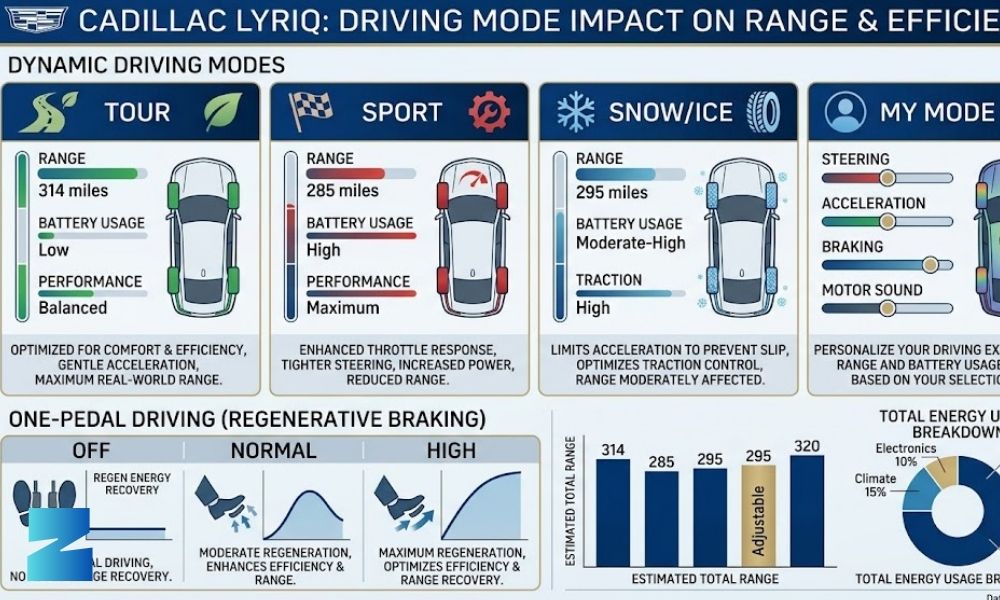

Many drivers get confused because the official range figure stays the same while their real-world range seems to shift from one mode to another. The reason is that official range is a standardized measurement. Real-world range is not. It changes constantly based on use.
If you drive at high speeds, use frequent hard acceleration, run strong cabin cooling or heating, carry extra weight, or drive in colder weather, range can drop even if the drive mode never changes. If you add a sportier mode to that mix, the effect may become even more noticeable.
That is why drive modes should be understood as part of a range system, not as the whole range story. The mode can influence the vehicle’s energy behavior, but it always works together with driver habits and road conditions.
Battery usage versus battery capacity
Another common misunderstanding is the idea that drive modes change the battery pack itself. They do not. The LYRIQ still uses the same battery capacity regardless of the selected mode. What changes is the rate at which stored energy may be used under different conditions.
This is an important difference. Battery capacity is like the size of your fuel tank. Battery usage is like how fast you burn through what is inside. The mode affects the second part much more than the first.
Once drivers understand that distinction, the whole subject becomes easier. You are not getting a new battery by choosing another mode. You are simply selecting a different personality for how the vehicle reacts, and that personality can influence how efficiently the energy gets used.
Regenerative braking and daily efficiency
One often-overlooked part of battery usage is regenerative braking. EV efficiency is not only about how energy is spent. It is also about how much can be recovered during slowing and braking. A smoother driving style usually gives regenerative systems a better chance to work consistently.
In daily driving, drivers who accelerate gently and slow down in a more controlled way often get better range than those who drive aggressively and brake hard. Even if the drive mode stays the same, this difference can be substantial.
That is why many EV owners focus more on habits than on mode labels alone. Drive mode matters, but it matters most when it supports a consistent, efficient style of driving. Good regenerative use, moderate speed, and smooth pedal inputs often matter more than a single switch on the console.
Temperature and climate control matter too
Even if a driver never changes modes, weather can still affect battery use in a very noticeable way. Cold temperatures, strong heating use, and even very hot weather with heavy air conditioning can all reduce practical range. These factors often matter more than the difference between two standard drive modes.
This is important for LYRIQ drivers because some people blame the mode when the bigger cause is actually the environment. Winter driving, uphill routes, fast highway cruising, and strong climate control use can all raise battery consumption.
So when comparing modes, drivers should be careful not to ignore the conditions around them. A range drop on a cold day in Sport mode may feel like the mode caused everything, when in reality the cold weather and cabin heat may be doing much of the work.
Which mode is best for daily range?
For most people, the best mode for range is the mode that makes the vehicle easiest to drive smoothly. In many cases, that will be the standard or everyday setting rather than the sportiest one. A calmer setup usually supports more measured acceleration and better efficiency in normal traffic.
This does not mean you must always avoid performance-focused modes. It simply means that if your top priority is stretching range, smoothness and moderation will usually help more than extra sharpness and speed. The best range often comes from consistency, not intensity.
Drivers who want to maximize battery life on longer trips are usually better off staying in the most balanced drive mode, using moderate speeds, and avoiding unnecessary bursts of hard acceleration. That combination tends to do more for practical range than any special trick.
Do different LYRIQ modes use the battery differently?
Yes, in practice they can. But the difference is not usually because one mode has its own official range number. The difference comes from how each mode changes the car’s behavior and how that behavior affects the driver’s energy use.
A performance-oriented mode can make the battery deplete faster if it encourages harder acceleration. A calm everyday mode can support better efficiency if it encourages smoother driving. A traction-focused mode may help in bad weather but may not improve range overall if the weather itself is already reducing battery performance.
So the most accurate answer is that the LYRIQ’s drive modes can lead to different real-world battery usage, but not usually in the form of clearly separated official range ratings for each mode.
The best way to think about LYRIQ driving modes
The simplest way to understand the issue is this: drive modes are more about vehicle behavior than battery math. They change how the car feels, how quickly it responds, and how confidently it handles certain situations. That can influence range, but usually indirectly.
If you think of a mode as a personality setting, the whole system makes more sense. One personality may be calm and efficient. Another may be sharper and more demanding. Another may focus on traction and control. The battery pack is still the same, but the way you use it shifts with the character of the car.
That is why two modes can produce different real-world results without ever having separate advertised range labels. The battery is not changing. The way the driver accesses and spends that battery energy is.
Final thoughts
The short answer to the question is yes, Cadillac LYRIQ driving modes can affect real-world battery usage, but usually not in the form of separate official range ratings. Everyday modes are generally better for smooth, efficient driving, while performance-focused settings can increase energy use by encouraging stronger acceleration.
For most drivers, the smartest approach is simple. Use the standard everyday mode for normal driving, save the aggressive performance settings for the moments when you really want them, and remember that weather, speed, and driving style often matter just as much as the mode itself.
That is the best way to understand the LYRIQ’s range story. The battery stays the same. The vehicle’s behavior changes. And that behavior, together with the way you drive, is what determines how far the charge really goes.
Detailed FAQs
Do Cadillac LYRIQ drive modes have different official range numbers?
Usually no. The LYRIQ is generally marketed with range figures based on vehicle version, not separate official range ratings for each normal drive mode.
Can LYRIQ drive modes affect real-world battery usage?
Yes. Different modes can change throttle response, traction behavior, and overall driving feel, which can influence how quickly the battery is used.
Does Sport mode reduce range in the Cadillac LYRIQ?
It can in real-world driving, especially if it encourages harder acceleration and more aggressive use of power.
Is the normal or everyday mode best for range?
In most cases, yes. A balanced daily mode usually makes it easier to drive smoothly, which often supports better efficiency.
Does Snow mode increase range?
Not necessarily. Snow mode is usually designed for traction and control, not maximum efficiency. Cold weather itself often reduces range regardless of mode.
Do performance-maximizing settings use more battery?
Yes, they generally can, because they are designed to deliver stronger acceleration and faster response.
Do drive modes change battery size?
No. The battery capacity stays the same. Drive modes affect how the vehicle uses that stored energy.
Is regenerative braking affected by driving style?
Yes. Smooth driving and controlled slowing usually help regenerative braking work more consistently, which can support better practical efficiency.
What affects LYRIQ range the most besides drive mode?
Speed, weather, cabin heating or cooling, terrain, tire condition, traffic, and driving style all have a major effect on range.
What is the best short answer to this question?
Cadillac LYRIQ drive modes can change real-world battery usage, but they usually do not come with separate official range ratings.