
ENTERTAINMENT
Las Vegas Raiders vs Colts Match Player Stats: Jonathan Taylor’s 3 TDs Lead 40-6 Rout

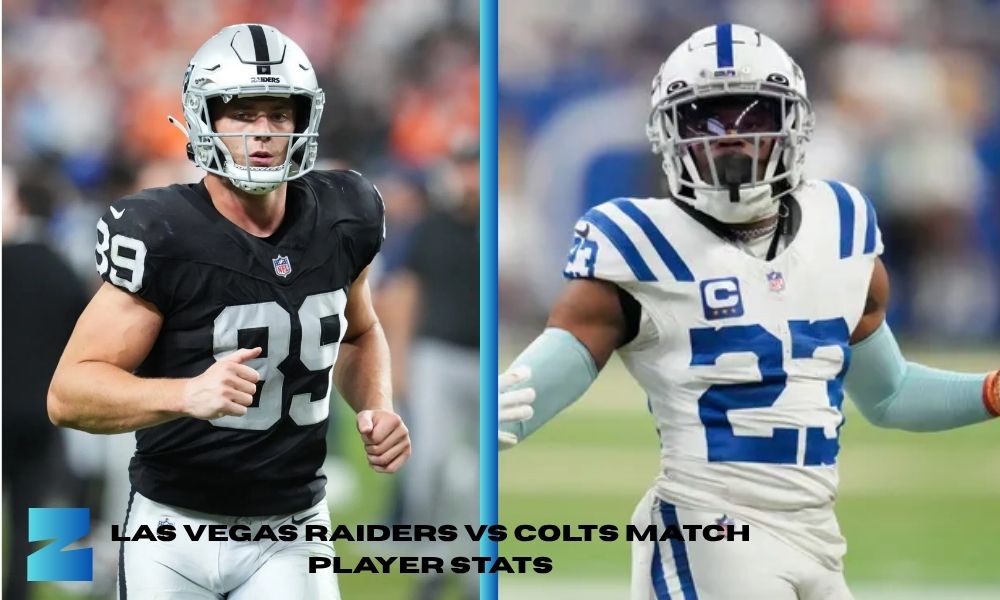 The Las Vegas Raiders vs Colts match player stats tell the story of a one-sided game: Indianapolis beat Las Vegas 40-6 on October 5, 2025 at Lucas Oil Stadium, with Jonathan Taylor scoring three rushing touchdowns and Daniel Jones throwing two touchdown passes. ESPN’s game summary shows the Colts outgained the Raiders 317-296, won the turnover battle 2-0, and finished a perfect 6-for-6 in the red zone, which is the clearest reason the game turned into a blowout.
Quick Bio Table
| Field | Details |
|---|---|
| Match | Las Vegas Raiders vs Indianapolis Colts |
| Date | October 5, 2025 |
| Final Score | Colts 40, Raiders 6 |
| Venue | Lucas Oil Stadium, Indianapolis |
| Top Colts Player | Jonathan Taylor |
| Taylor’s Line | 17 carries, 66 yards, 3 TDs |
| Colts QB | Daniel Jones |
| Jones’ Line | 20/29, 212 yards, 2 TDs |
| Raiders QB | Geno Smith |
| Smith’s Line | 25/36, 228 yards, 2 INT |
| Key Team Edge | Colts red zone: 6/6 |
| Biggest Swing | Colts scored 40 unanswered points after trailing 3-0 |
Match overview
This game started in a fairly normal way, with the Raiders taking a 3-0 lead on a 24-yard Daniel Carlson field goal after a long opening drive of 16 plays and 80 yards. After that, though, the game belonged almost entirely to Indianapolis. The Colts scored 40 unanswered points, including 20 in the second quarter and 20 more in the third, before the Raiders finally added another field goal in the fourth.
What makes that scoring pattern important is that it shows the Colts were not just slightly better. They were dramatically more efficient when scoring chances appeared. Las Vegas moved the ball enough to finish with 296 total yards and 22 first downs, but the Raiders went 0-for-4 in the red zone and turned the ball over twice. Indianapolis, by contrast, turned 24 first downs into 40 points because nearly every meaningful drive ended the right way.
Raiders vs Colts passing stats
The quarterback comparison was one of the biggest reasons the result felt so lopsided. For the Raiders, Geno Smith completed 25 of 36 passes for 228 yards but threw 2 interceptions and no touchdowns. For the Colts, Daniel Jones went 20 of 29 for 212 yards and 2 touchdowns with no interceptions listed in the ESPN summary. Even though Smith had slightly more passing yards, Jones delivered the far cleaner and more valuable game.
That is a good example of why raw passing yards can be misleading. Smith’s 228 yards look fine at first glance, but the two interceptions killed drives and gave Indianapolis extra control. Jones had fewer passing yards, yet he finished drives with touchdown throws to Tyler Warren and Michael Pittman Jr., which made his stat line much more impactful. In a game where one quarterback protects the ball and throws touchdowns while the other turns it over twice, the yardage gap barely matters.
The Colts’ passing attack also arrived at the right moments. Jones’ first touchdown was an 11-yard pass to Tyler Warren with 11:33 left in the second quarter, giving Indianapolis its first lead at 7-3. His second scoring throw was a 4-yard pass to Michael Pittman Jr. with 15 seconds left in the first half, pushing the score to 20-3 and putting the Raiders in a deeper hole before halftime.
Jonathan Taylor and the rushing battle
If one player defined this matchup, it was Jonathan Taylor. ESPN’s game leaders show Taylor finished with 17 carries for 66 yards and 3 touchdowns, and the AP recap headline focused on him immediately. His rushing total was not huge by volume standards, but the scoring impact was enormous. Indianapolis trusted him near the goal line, and he delivered over and over.
Taylor’s three rushing scores came from 3 yards, 1 yard, and 6 yards. His final touchdown, with 2:27 left in the third quarter, was followed by a successful two-point run by Taylor himself, pushing the lead to 40-3. That sequence effectively ended any realistic comeback hopes for Las Vegas.
The Raiders’ top rusher was Ashton Jeanty, who had 14 carries for 67 yards, just one more rushing yard than Taylor. But this game shows the difference between rushing yardage and rushing value. Jeanty’s numbers helped the Raiders move the ball, yet Las Vegas never turned those rushing opportunities into touchdowns. Taylor, on the other hand, turned short-yardage chances into points three times.
That difference also connects directly to the red-zone stats. Indianapolis went 6-for-6 in the red zone, while Las Vegas went 0-for-4. So even though the rushing-yard leaders were nearly even, one team used its run game to finish drives and the other did not. That is one of the simplest and strongest explanations for a 34-point final margin.
Receiving leaders and touchdown targets
In receiving, the Raiders’ top yardage producer was Tre Tucker, who had 4 catches for 62 yards. For Indianapolis, Ashton Dulin led the Colts in receiving yards with 2 catches for 55 yards. These were not massive receiving totals on either side, which again shows this game was shaped more by efficiency and finishing than by explosive volume.
The most important Colts receivers were not necessarily the yardage leaders but the touchdown scorers. Tyler Warren caught the first Colts touchdown, and Michael Pittman Jr. added the second receiving score just before halftime. Those two plays gave Indianapolis control of the game before Taylor’s third-quarter dominance turned control into a rout.
For Las Vegas, the passing game moved between the 20s better than the final score suggests. Smith threw for over 200 yards, and Tucker’s 62 receiving yards helped stretch the field some. But without a receiving touchdown, and with the offense producing only two field goals, the receiving stats became empty compared with the Colts’ far more efficient scoring profile. This is an inference based on the box score and scoring log.
Defensive and turnover stats
Turnovers were one of the clearest dividing lines in this game. ESPN lists the Raiders with 2 turnovers and the Colts with 0. In a matchup where overall yardage was relatively close, that clean turnover edge gave Indianapolis extra possessions and removed almost any path for Las Vegas to stay competitive.
The Colts’ defensive playmakers showed up in several ways. ESPN’s leaders list DeForest Buckner with 1 sack, while Julian Blackmon? no—ESPN instead highlights Jonathan Chinn as the tackles leader with 10 tackles, 5 solo. The Colts’ own game-center coverage also highlighted a Mekhi Blackmon interception, a Laiatu Latu interception, and a Zaire Franklin sack, reinforcing that Indianapolis’ defense produced disruptive plays all afternoon.
That defensive pressure mattered because the Raiders were not completely shut down in yardage terms. They still had 296 total yards, 22 first downs, and over 33 minutes of possession. But the Colts made sure those drives rarely ended well. Las Vegas spent time with the ball, yet Indianapolis owned the high-leverage moments: sacks, red-zone stops, and turnovers.
Team stats that decided the game
At first glance, the team stats do not look like a 40-6 blowout. Total yards were 317 for Indianapolis and 296 for Las Vegas. First downs were 24-22. Third-down conversion rates were both strong, with the Raiders at 8-for-14 and the Colts at 8-for-10. Those numbers suggest a much tighter contest.
But two categories made the real difference. First was turnovers: Raiders 2, Colts 0. Second was red-zone performance: Raiders 0-for-4, Colts 6-for-6. Those two lines explain almost the entire game. Las Vegas could move the ball, but not score touchdowns. Indianapolis did not waste chances. That is why similar yardage totals produced wildly different point totals.
The possession numbers are also interesting. The Raiders actually held the ball longer, 33:25 to 26:35. Usually, that kind of possession edge helps a team stay in the game. Here it did not, because the Colts were simply much more explosive and decisive when they had chances. This is another example of how efficiency can matter more than possession time in a single-game NFL stat line.
Scoring summary by quarter
The quarter-by-quarter line tells the full story of momentum. Las Vegas led 3-0 after the first quarter. Then Indianapolis exploded for 20 points in the second quarter and another 20 in the third, building a 40-3 lead before the Raiders closed the scoring with a fourth-quarter field goal.
The second quarter was where the game truly flipped. The Colts scored on a Tyler Warren touchdown catch, a Jonathan Taylor rushing touchdown, and a Michael Pittman Jr. touchdown catch. By halftime, the Raiders had gone from leading to trailing by 17 points. Once that happened, Las Vegas had to chase the game, which made the Colts’ defense even more dangerous.
The third quarter then removed all suspense. Taylor added two more rushing touchdowns, and Indianapolis also got a short Ameer Abdullah 2-yard rushing touchdown in between. That burst pushed the score to 40-3, turning the final period into cleanup time rather than a real contest.
Best individual performances
The best individual performance was clearly Jonathan Taylor’s 3-touchdown day. Even with only 66 rushing yards, he was the game’s most important player because he repeatedly ended drives with points. In a stat-based article, touchdowns matter, and no one matched Taylor’s scoring impact.
The second standout was Daniel Jones, whose line of 20-of-29 for 212 yards and 2 touchdowns gave Indianapolis exactly what it needed: control, accuracy, and no damaging mistakes in the summary box. He did not need a monster fantasy-style total because the Colts dominated situational football.
For the Raiders, Geno Smith and Ashton Jeanty had the most visible offensive numbers, but neither could turn production into points. Smith’s 228 passing yards were undone by the interceptions, and Jeanty’s 67 rushing yards did not produce a touchdown. Tre Tucker’s 62 receiving yards made him the Raiders’ top receiving weapon, but again, there was no trip to the end zone.
What the player stats really say
The biggest takeaway from the Las Vegas Raiders vs Colts match player stats is that this was not a total-yardage blowout as much as it was a finishing blowout. Indianapolis was better where it mattered most: turnovers, red zone, touchdowns, and momentum swings. That is why a game with fairly competitive yardage still ended 40-6.
It is also a reminder that fantasy-style surface stats can hide the true story. Smith throwing for 228 yards and Jeanty running for 67 could make the Raiders’ offense look respectable. But real-game value came from Indianapolis turning good drives into touchdowns and Las Vegas failing to do that four times in the red zone. This is an inference from the box score and scoring summary.
For Indianapolis, the formula was simple and devastating: Daniel Jones distributed the ball efficiently, Jonathan Taylor finished drives, and the defense avoided mistakes while forcing two turnovers. That combination made the Colts’ offense look clinical rather than flashy, and it was more than enough to crush Las Vegas on the day.
Detailed FAQs
Who won the Las Vegas Raiders vs Colts game on October 5, 2025?
The Indianapolis Colts won 40-6 over the Las Vegas Raiders at Lucas Oil Stadium.
Who had the best stats in Raiders vs Colts?
Jonathan Taylor had the standout stat line for Indianapolis with 17 carries, 66 yards, and 3 rushing touchdowns. Daniel Jones also played well with 212 passing yards and 2 touchdowns.
What were Geno Smith’s stats against the Colts?
Geno Smith finished 25 of 36 for 228 yards and 2 interceptions.
What were Daniel Jones’ stats against the Raiders?
Daniel Jones went 20 of 29 for 212 yards and 2 touchdown passes.
How many touchdowns did Jonathan Taylor score vs the Raiders?
Jonathan Taylor scored 3 rushing touchdowns.
Who led the Raiders in rushing yards?
Ashton Jeanty led Las Vegas with 67 rushing yards on 14 carries.
Who led the game in receiving yards?
For Las Vegas, Tre Tucker led with 62 receiving yards. For Indianapolis, Ashton Dulin led with 55 receiving yards.
What were the key team stats in Raiders vs Colts?
The Colts had 317 total yards, no turnovers, and went 6-for-6 in the red zone. The Raiders had 296 total yards, 2 turnovers, and went 0-for-4 in the red zone.
Why was the final score so lopsided if the yardage was close?
Because Indianapolis was far better in the most important categories: touchdowns, turnovers, and red-zone efficiency. The Colts finished drives; the Raiders did not. This is an inference from the box score.
How did the scoring unfold?
The Raiders led 3-0 after the first quarter, but the Colts then scored 40 straight points before Las Vegas added a late field goal.
Did the Raiders have more time of possession?
Yes. Las Vegas had the ball for 33:25, while Indianapolis had it for 26:35.
What was the biggest stat from the game?
The most important stat was probably the Colts going 6-for-6 in the red zone while the Raiders went 0-for-4. That stat explains the scoring gap better than total yardage does.

Pravi Celer Explained: Benefits, Uses, Nutrition, and Why This “True Celery” Is Trending

Carla Diab: The Fashion, TV, and Business Story Behind Her Rising Name

Arleata Williams: The Private Life of Otis Williams’ Former Wife and the Family Story Behind the Name

Pixelspinx com Explained: Why This Growing Website Is Getting Attention

Dorothy Bowles Ford: The Quiet Story Behind the Ford Political Family Legacy

Antonimar Mello: The Private Life Behind Lisa Lisa’s Marriage, Family, and Quiet Public Image
-
 TECH2 days ago
Pixelspinx com Explained: Why This Growing Website Is Getting Attention
-
 BLOG7 days ago
Dorothy Bowles Ford: The Quiet Story Behind the Ford Political Family Legacy
-
 CELEBRITY5 days ago
Antonimar Mello: The Private Life Behind Lisa Lisa’s Marriage, Family, and Quiet Public Image
-

 BLOG7 days ago
Ann-Lorraine Carlsen Nantz: Inside Jim Nantz’s First Marriage, Divorce, and Private Life
-

 CELEBRITY7 days ago
Charity Nye: The Truth Behind Bill Nye’s Rumored Daughter and the Online Mystery
-

 NEWS6 days ago
Ana Leza: The Private Life, Acting Career, and Marriage That Shaped Antonio Banderas’ Early Rise
-

 CELEBRITY5 days ago
wedding charles latibeaudiere wife: Inside His Marriage to Barbara Sherwood
-

 CELEBRITY6 days ago
Dallas Yocum: The Private Life Behind Mike Lindell’s Shortest and Most Talked-About Marriage