
TECH
Pixelspinx com Explained: Why This Growing Website Is Getting Attention


In a digital world filled with niche blogs and content platforms, Pixelspinx.com stands out as a multi-topic website that covers a mix of subjects rather than focusing on only one narrow category. For many readers, the main question is simple: what exactly is Pixelspinx.com, and why are people starting to search for it? The answer begins with its broad publishing style, its accessible layout, and its range of articles across business, finance, travel, health, technology, and more.
| Quick Bio | Details |
|---|---|
| Name | Pixelspinx.com / Pixel Spinx |
| Type | Multi-niche content website |
| Main Tagline | “Where Pixels Dance and Imagination Takes Flight” |
| Content Areas Seen | Entertainment, Health, Travel, Business, Education, Fashion, Finance, Sports |
| Additional Categories Seen | Automotive, General, Online Game, Technology |
| Publishing Style | Informational blog-style articles |
| Audience | Readers looking for mixed-topic web content |
| Main Interest | General information, explainers, and online reading |
Introduction to Pixelspinx.com
Pixelspinx.com appears to be built as a broad-content platform rather than a tightly specialized publication. That matters because many websites today try to dominate one subject, but Pixelspinx seems to go in the other direction. It offers articles in several areas, including travel, finance, health, technology, and general interest topics. On the homepage, the site presents itself with the line “Where Pixels Dance and Imagination Takes Flight,” which suggests a creative identity more than a corporate or academic one.
This broad identity shapes how people see the site. A visitor who lands on Pixelspinx.com may not come for a single brand-defining topic. Instead, they may arrive through a search result for one article and then discover the platform hosts many unrelated subjects. That kind of structure is common among modern multi-niche blogs. It helps a site pull traffic from different search terms, but it also creates a challenge. The website must still feel organized enough that readers understand what it offers.
In the case of Pixelspinx.com, the available public pages show that it is not limited to one audience type. Someone interested in travel advice may find an article there. A business-focused reader may land on a financing topic. A technology reader may find a separate post. This flexibility is part of the site’s appeal. It allows it to capture interest from several corners of the internet instead of depending on one content lane alone.
What Kind of Website Is Pixelspinx.com?
The clearest way to describe Pixelspinx.com is as a multi-category publishing site. Its homepage and category pages show posts spread across different subjects, with visible sections such as Entertainment, Health, Travel, Business, Education, Fashion, Finance, and Sports. Other visible categories include Automotive, General, Online Game, and Technology. That tells us the website is not positioned as a personal blog in the traditional sense. It looks more like a content hub designed to appeal to broad reader interest.
This type of site usually works by publishing searchable articles on many topics that people commonly look up online. Instead of expecting users to visit the homepage first, the site likely depends on search traffic. A reader may search for a specific phrase, land on one article, and only then learn the larger site exists. That traffic model is popular because it allows websites to grow through many small search opportunities.
There is another reason this matters. When readers search for Pixelspinx.com, they are often not just asking whether the site exists. They are usually trying to understand what it represents. Is it a news site? A tech brand? A digital magazine? A content farm? A niche blog? Based on the available pages, the most balanced answer is that Pixelspinx.com is a general content publishing platform with a multi-topic blog format.
The Content Categories That Define Pixelspinx.com
One of the most important things about Pixelspinx.com is the way its categories shape user expectations. Categories are more than labels. They tell readers what kind of site they are visiting and how seriously the platform organizes information. On Pixelspinx, the visible categories span practical, lifestyle, and informational topics. That alone gives the site a flexible identity.
For example, finance-related posts appear on the site, including an article on small business loans in California for minority-owned businesses. Travel content is also present, including a post about where to see the northern lights in the USA. Technology content appears as well, including pages discussing WordPress developers and technology-related locations. This range suggests that Pixelspinx.com is trying to capture traffic from broad informational searches instead of building around a single editorial mission.
That does not automatically make the site weak or unfocused. In fact, many successful websites begin as broad blogs. What matters more is how clearly the categories are arranged and whether readers can move from one topic to another without confusion. Pixelspinx appears to have recognizable category navigation, which helps visitors explore different sections even when the subjects vary widely.
Why People Search for Pixelspinx.com
When people search for a domain name directly, there is usually a reason beyond simple curiosity. In the case of Pixelspinx.com, users may be searching the website for several possible reasons.
First, they may have seen one of its articles in search results and want to know whether the platform is trustworthy or what kind of site it is. This is especially common when a site covers many unrelated topics. Readers often pause to understand the source before spending time on more pages.
Second, some users may be looking for a particular article. Multi-topic websites often publish posts built around highly searchable phrases. Someone may remember the site because they read a guide on finance, travel, login help, or digital services and now want to revisit it.
Third, some people may simply be curious because the name Pixelspinx is memorable. It sounds modern, brandable, and creative. A distinctive domain name often encourages direct search behavior, especially when it feels different from plain generic websites.
That combination of broad content and a memorable name may explain why the domain itself becomes a keyword. Readers do not only search article topics. They also search site names once a platform begins appearing often enough in their browsing journey. This suggests that Pixelspinx.com has at least some visibility as a recognizable web property, not just as a random one-off domain. That last point is an inference based on the site’s indexed pages and branded homepage presentation.
The Homepage Style and First Impression
A website’s homepage often tells visitors whether the site feels serious, casual, corporate, creative, or experimental. Pixelspinx.com uses the tagline “Where Pixels Dance and Imagination Takes Flight,” which gives it a more expressive and creative tone than a standard business blog. This is an interesting choice because the actual article topics appear practical and search-driven. That contrast makes the brand identity slightly more imaginative than the content mix alone might suggest.
The homepage also appears to highlight recent articles and category navigation. This is typical of magazine-style or blog-style websites that depend on multiple posts to drive engagement. Instead of centering the brand around one flagship product or service, the site emphasizes published content and lets the reader browse by topic. That layout helps visitors quickly understand that Pixelspinx is content-focused.
First impressions matter a great deal online. When readers land on a site from Google, they often decide within seconds whether the platform feels worth trusting. Category visibility, clear article titles, and a readable homepage structure all contribute to that decision. Pixelspinx.com’s visible layout suggests it wants to function as a general reading platform rather than a personal portfolio or company brochure.
Examples of Topics Published on Pixelspinx.com
Looking at a few visible article titles helps explain how the platform works. On the homepage and category pages, examples include pieces about small business loans in California, northern lights viewing in the USA, vehicle transport quotes, Kibho login and registration, online poker versus Teen Patti, WordPress developers for scalable digital experiences, and technology-related location pages.
That spread is important. It shows that the site is not bound by one editorial voice or one reader persona. Instead, it is likely built to answer search-based questions across several niches. In SEO terms, this means Pixelspinx.com may be pursuing wide keyword coverage rather than narrow topical authority.
There are benefits to this. A site with many topic types can reach more people. It can test what performs best. It can adapt faster. If one category slows down, another can bring in readers. For newer or mid-sized websites, this approach can feel efficient.
Still, there are trade-offs. Readers sometimes trust specialized websites more than broad ones. A travel reader may wonder why the same platform also writes about fintech, gaming, or login topics. That does not automatically reduce value, but it does mean the site must work harder to build credibility article by article.
Is Pixelspinx.com a News Site or a Blog?
 Based on the publicly visible structure, Pixelspinx.com looks closer to a blog-style content platform than a traditional newsroom. It features article listings, category pages, and broad informational titles rather than time-sensitive reporting or heavily reported news coverage. That suggests the site’s purpose is more about answering search-driven questions and publishing evergreen or semi-evergreen content than breaking major news stories.
This distinction matters because readers use “site,” “blog,” “magazine,” and “news platform” in different ways. A blog-style site often focuses on discoverable information, accessible reading, and topic variety. A news platform usually centers on timely reporting, source attribution, and a consistent editorial beat. Pixelspinx.com appears more aligned with the first model.
That does not lessen its usefulness. Many blog-style sites are valuable because they simplify subjects for readers. They may not behave like newspapers, but they still meet user needs by providing accessible overviews, tips, or explanations. Pixelspinx.com seems built for that style of utility.
The SEO Value of a Site Like Pixelspinx.com
From a digital publishing perspective, Pixelspinx.com offers an interesting case study in multi-topic SEO. A site like this can target many types of keywords, which increases the number of possible entry points from search engines. Instead of betting everything on one niche, it spreads risk across many queries.
For example, one visitor may arrive through a finance-related search. Another may come through travel. Another through technology. Another through a how-to or login-style query. If the site is indexed well and keeps publishing consistently, those mixed streams can build a sizable footprint over time. The visible pages suggest Pixelspinx.com has content across multiple dates and topic clusters, which supports that type of strategy.
However, SEO success for a broad platform depends on balance. Publishing across many categories is not enough. Each post still needs quality, clarity, helpfulness, and good structure. Modern search performance depends heavily on whether content truly satisfies user intent. So the strength of Pixelspinx.com is not just that it covers many subjects. Its future value depends on how well each subject is handled.
For bloggers and site owners, there is a useful lesson here. Pixelspinx.com shows how a memorable domain and broad content model can create search visibility. But it also highlights the importance of giving readers enough confidence to stay, read, and return.
What Makes the Pixelspinx Name Memorable?
The name itself deserves attention. Pixelspinx is distinctive, modern, and slightly playful. The word “pixel” naturally suggests digital media, visuals, or online creativity. The second half, “spinx,” sounds stylized and brand-driven. Together, the name feels more like a creative web brand than a plain informational site.
This matters because names influence perception. A website called something generic may blend into the background. A name like Pixelspinx is easier to remember, easier to search again, and more likely to stick in a reader’s mind after one visit. That branding advantage can help even before a site develops strong authority.
A memorable domain does not guarantee trust, of course. But it does improve recall. In crowded online spaces, recall matters a lot. If readers can remember the name of the site where they found useful information, they are more likely to return or search for it later.
How Readers Should Approach Pixelspinx.com
Readers should approach Pixelspinx.com the same way they approach any broad-content website: with curiosity, but also with attention to article quality and source context. Multi-topic sites can be useful, especially for quick explainers and practical reading. But because they cover many subjects, not every article will carry the same level of depth or authority.
A sensible reader asks a few simple questions. Does the article clearly answer the topic? Is the structure readable? Does it seem written to help, or just to attract clicks? Is the content fresh enough for the topic? These questions apply not only to Pixelspinx.com, but to almost every modern information site.
That balanced approach is especially important on subjects that require greater care, such as finance, health, or technical guidance. For lighter topics, general reading may be enough. For higher-stakes topics, readers should cross-check important details with stronger primary or specialist sources.
Final Thoughts on Pixelspinx.com
Pixelspinx.com appears to be a multi-topic content website with a creative brand identity and search-driven publishing model. It covers a wide range of categories, including finance, travel, health, technology, business, and general interest topics. Its homepage branding and visible category structure suggest it is designed to attract readers through multiple keyword paths rather than one narrow specialty.
That makes the site interesting for both readers and content creators. Readers may find useful articles across different subjects. Content strategists may see it as an example of how broad-topic publishing can build visibility. At the same time, its wide scope means readers should judge each piece on its own quality and usefulness.
If you searched for Pixelspinx.com because the name keeps appearing online, the clearest answer is this: it is a general-content web platform that publishes across multiple categories and presents itself with a creative, magazine-like tone. It is not just one article or one niche. It is a broader content brand trying to build attention through variety.
Detailed FAQs About Pixelspinx.com
What is Pixelspinx.com?
Pixelspinx.com is a multi-topic content website that publishes articles across categories such as finance, travel, health, technology, and general interest.
Is Pixelspinx.com a blog or a news site?
Based on its visible structure and article presentation, it appears closer to a blog-style or magazine-style content platform than a traditional news site.
What topics does Pixelspinx.com cover?
The site shows categories including Entertainment, Health, Travel, Business, Education, Fashion, Finance, Sports, Automotive, General, Online Game, and Technology.
Why are people searching for Pixelspinx.com?
People may search for the domain because they saw one of its articles, want to revisit the site, or are curious about what kind of platform it is. This is an inference based on the site’s branded homepage and indexed article pages.
Does Pixelspinx.com focus on one niche?
No. The visible public pages suggest it follows a broad multi-niche content strategy rather than limiting itself to one single subject area.
Is Pixelspinx.com useful for readers?
It can be useful for readers looking for general informational articles across different topics, though the value of each article should be judged individually.
What is the tagline of Pixelspinx.com?
The homepage presents the line: “Where Pixels Dance and Imagination Takes Flight.”
Does Pixelspinx.com publish finance content?
Yes. Visible finance-related pages include articles such as one on small business loans in California and other finance-tagged content.
Does Pixelspinx.com publish travel content?
Yes. One visible example is an article about where to see the northern lights in the USA.
Does Pixelspinx.com publish technology content?
Yes. Publicly visible technology pages include articles related to WordPress developers and technology-themed location posts.
Is Pixelspinx.com a brandable name?
Yes, it appears highly brandable because it is distinctive, memorable, and digitally styled. That is an inference based on the name itself rather than a claim from the site.
Why does a site like Pixelspinx.com matter in SEO?
A broad-content platform can target many search terms across different categories, which may help it attract readers from multiple types of online searches. This is a general SEO inference supported by the site’s visible multi-category structure.

When people search “Schoology Alfa,” they are usually not looking for a separate education company or a brand-new platform. The strongest public evidence points instead to ALFA Fundación’s branded Schoology portal, hosted at alfafundacion.schoology.com, which redirects users into a Microsoft sign-in flow tied to Schoology. In simple terms, Schoology Alfa appears to be a customized access point for an institution using Schoology Learning rather than a standalone product of its own. To understand that setup, it helps to know that Schoology itself is a learning management system, which schools use to organize courses, assignments, grades, and communication in one place.
| Quick Bio | Details |
|---|---|
| Search Term | Schoology Alfa |
| Best Current Meaning | A branded Schoology portal for ALFA Fundación |
| Main URL Seen Publicly | alfafundacion.schoology.com |
| Platform Behind It | Schoology Learning by PowerSchool |
| Likely Access Method | Microsoft-based sign-in / SSO |
| Used For | Courses, assignments, communication, and school learning workflows |
| Not Best Understood As | A separate standalone learning platform |
The reason this keyword confuses people is that the name sounds like it could belong to a dedicated app or a private education tool. But the public search trail suggests something more practical: a school or organization has branded its Schoology environment with the name ALFA, and users are searching that name because that is the label they see during login or daily use. PowerSchool describes Schoology Learning as a K–12 learning management system that connects teachers, students, and families in a centralized hub for personalized teaching and learning. So when users type “Schoology Alfa,” they are most likely searching for their school’s version of Schoology, not a separate competitor.
This matters because search intent around education portals is usually very practical. Students are often trying to log in, check assignments, find missed work, or see course materials. Parents may want grades, updates, and communication. Teachers may be looking for course tools, assessments, discussions, or roster syncing. In that context, “Schoology Alfa” behaves more like a school-branded entry point than a public-facing education brand. The ALFA Fundación portal result and its sign-in redirect strongly support that interpretation.
Schoology Alfa Is Best Understood as a Branded Portal
The clearest public clue is the domain itself: alfafundacion.schoology.com. That structure is exactly what you would expect from an organization running its own Schoology environment under a branded subdomain. When opened publicly, that portal redirects into Microsoft’s authentication system, which suggests the organization likely uses Microsoft-based single sign-on for access. That is common in school technology setups because it lets students and staff use institutional credentials rather than separate usernames and passwords.
So, if someone asks “What is Schoology Alfa?” the best answer is this: it appears to be ALFA Fundación’s Schoology login and learning portal, built on the Schoology Learning platform. It is not clearly presented in public evidence as an independent LMS with separate ownership, feature architecture, or branding outside the Schoology ecosystem. That distinction helps prevent the most common misunderstanding around the keyword.
What Schoology Learning Actually Does
To understand Schoology Alfa, you first need to understand what Schoology itself does. PowerSchool describes Schoology Learning as a platform built for K–12 teaching and learning. Its public help and product pages show that it supports core classroom functions such as courses, assignments, assessments, discussions, resources, and communication. In other words, it is the digital space where much of school life can be organized and delivered.
Assignments are a basic example. Schoology’s student help documentation says assignments are graded materials that can require file submission, and that students may upload files, create documents on the web, or submit materials from their resources. The same help documentation lists broad file support, including common document, spreadsheet, image, audio, and video formats. That shows why a branded portal like Schoology Alfa would be useful for everyday coursework rather than just announcements or login access.
Assessments are another major part of the platform. PowerSchool’s Schoology help says assessments are created to measure student understanding or readiness and are automatically graded unless they contain subjective question types. The documentation also notes that instructors can rescore submissions, use rubrics, and adjust settings. A separate official help page lists many available assessment question types, including multiple choice, true/false, matching, short answer, audio, video, file upload, image-based items, and math-focused formats. That makes Schoology more than a content folder. It is also an active teaching and evaluation environment.
Discussions are built in too. The student help documentation describes discussions as interactive conversations with threaded commenting, and notes that some courses may use moderation before posts become visible. This kind of feature is important because it turns the portal into a classroom community space, not just a place to download homework. If ALFA Fundación is using Schoology in a typical institutional way, then Schoology Alfa likely supports not only task delivery but also classroom interaction.
Why Students Search Schoology Alfa So Often
Most education portal searches are driven by urgency. A student needs to log in before class. Someone forgot where assignments are posted. A parent wants to check what is due this week. A teacher needs to review materials, sync something, or locate course discussions. That is why branded LMS searches often look highly specific. Users search the exact phrase they remember from the login page or school instructions. In this case, “Schoology Alfa” likely reflects that behavior.
Another reason the keyword keeps appearing is that school-branded portals can feel like separate products to everyday users. A student may never think in terms of “PowerSchool’s Schoology Learning instance customized for my institution.” They just know, “My school uses Schoology Alfa.” That everyday language becomes the search keyword. Over time, the branded portal name gains its own search footprint even though the underlying platform remains Schoology.
What Users Can Likely Do Inside Schoology Alfa
While the public cannot see inside a private institutional portal without credentials, the official Schoology documentation makes it possible to infer the core functions Schoology Alfa likely provides. If it is a standard Schoology Learning environment, users would typically access courses, assignments, assessments, grades, calendars, resources, and group-based interactions through the platform. PowerSchool’s parent flyer also describes Schoology Learning as keeping courses, grades, and communication in a single platform for teachers, students, and parents.
For students, that usually means checking due dates, submitting work, joining discussions, taking assessments, and reviewing feedback. For teachers, it can mean posting lessons, grading submissions, managing course materials, and setting options on assignments. Official instructor help notes assignment controls such as individual assignment, submission settings, comments, grade statistics, grade counting, and returning work to students with feedback.
For parents, Schoology can serve as a visibility tool rather than a teaching space. PowerSchool’s parent materials and help content show that the wider Schoology ecosystem is designed to support parent awareness of learning progress, course information, and communication. So if families are also part of the ALFA portal setup, Schoology Alfa may work as a window into student progress rather than just a student-only classroom interface.
How Schoology Connects With School Data
One of the more powerful features in official documentation is Schoology’s ability to connect with a student information system, or SIS. PowerSchool’s SIS Connect guide says Schoology can provision schools, terms, users, courses, and enrollments from the SIS into Schoology, and can also send grade items and grade updates back from Schoology into the SIS. The same guide explains that organizations can choose manual or scheduled syncing and can map schools and grading terms across systems.
That matters because it shows Schoology Alfa is probably not just a static website. If ALFA Fundación is using Schoology in a fully implemented way, the portal may be tied directly into school data structures such as terms, enrollments, and grade workflows. That kind of integration is one reason LMS portals become central to daily school operations. They save time and help keep everyone working from the same academic structure.
Why Branded Portals Like Schoology Alfa Matter
A branded portal helps an institution make a big platform feel local and familiar. Students may trust it more because it carries the school or foundation name they already know. Staff can communicate more clearly because they can say “log into Schoology Alfa” instead of explaining the broader Schoology product ecosystem every time. In daily practice, that kind of branding reduces friction.
It also helps explain why search traffic around such portals can grow. Portal searches are not always driven by public curiosity the way celebrity searches are. They are driven by repeated need. Every school day creates more login attempts, more assignment checks, more grade reviews, and more communication needs. That kind of repeat behavior can make a branded portal term feel highly visible in search even if it is not widely discussed in public media.
Newer Features and the Future of the Platform
Schoology’s recent help and release materials also show that the platform continues to evolve. Current help pages and release notes mention newer items such as PowerBuddy for Learning and Google Assignments improvements. Parent-facing PowerBuddy documentation says that when enabled by a teacher, students can ask questions about an assignment topic, get hints, receive step-by-step help, and stay on-topic with content filters. That suggests the Schoology ecosystem is moving beyond basic content delivery and into AI-supported learning assistance.
So if ALFA Fundación continues using Schoology actively, Schoology Alfa may benefit from the same expanding feature set over time. That does not mean every school enables every feature, but it does mean the portal sits on top of a platform that is still being updated and extended. For users, that translates into a learning environment that can become more interactive and more capable without requiring a brand-new system.
Final Thoughts
The best current answer is that Schoology Alfa is not a separate learning platform. It appears to be ALFA Fundación’s branded Schoology Learning portal, with access routed through Microsoft authentication and functionality built on PowerSchool’s Schoology system. That means users searching the term are probably looking for their institution’s login or course space, not trying to discover a new standalone edtech product.
That is why the keyword matters. “Schoology Alfa” reflects real user behavior in schools: people search the branded name they see every day. Behind that name sits a full LMS environment that supports assignments, assessments, discussions, resources, and school-data integrations. So while the phrase may sound mysterious at first, its most likely meaning is actually simple and practical: it is the Schoology portal people at ALFA use to teach, learn, submit work, and stay connected.
FAQs
What is Schoology Alfa?
Schoology Alfa appears to be ALFA Fundación’s branded Schoology Learning portal, not a separate standalone LMS product.
Is Schoology Alfa a different company from Schoology?
Public evidence does not suggest that. It appears to be a custom-branded Schoology domain used by an institution, while the underlying platform is Schoology Learning by PowerSchool.
What can users do in Schoology Alfa?
If it functions like a standard Schoology environment, users can likely access courses, assignments, assessments, discussions, grades, and communication tools.
Why does Schoology Alfa use Microsoft login?
Opening the public portal redirects to Microsoft authentication, which suggests the institution likely uses Microsoft-based single sign-on for access.
Can Schoology connect with school records and grades?
Yes. Official Schoology documentation says SIS Connect can provision schools, terms, users, courses, and enrollments from an SIS into Schoology and can send grade items and grade updates back to the SIS.
Is Schoology Alfa mainly for students?
It is likely used by students, teachers, and possibly parents, since official Schoology materials describe the platform as supporting courses, grades, and communication across those groups.
Does Schoology support assessments and discussions?
Yes. Official help pages show support for assessments with many question types and for threaded course discussions.
For More Info Visit Zentomagazine.co.uk

Many drivers wonder whether the different drive modes in the Cadillac LYRIQ change the car’s actual range or battery usage in a major way. The clearest answer is that the modes can affect real-world energy use, but they do not usually come with separate official range ratings. In everyday driving, the biggest difference comes from how each mode changes throttle response, power delivery, traction behavior, and how aggressively the vehicle encourages performance. So while the battery pack stays the same, the way the vehicle uses that energy can feel different from one mode to another.
Quick Bio Table
| Field | Details |
|---|---|
| Vehicle | Cadillac LYRIQ |
| Main Question | Do drive modes change range or battery usage? |
| Short Answer | They can affect real-world efficiency, but not usually official EPA range ratings |
| Battery Focus | Same battery, different driving behavior |
| Most Efficient Use | Usually smoother everyday driving |
| Highest Battery Use | Aggressive performance-focused driving |
| Key Exception | Performance-maximizing settings can drain battery faster |
| Best Driver Takeaway | Modes affect usage more than they change official advertised range |
Do Cadillac LYRIQ driving modes have different official ranges?
For most drivers, this is the first and most important question. The answer is generally no. Cadillac promotes the LYRIQ with range figures based on the vehicle version, such as rear-wheel drive or all-wheel drive, not by assigning one official range number to each drive mode. That means you will not usually see separate factory ratings for Tour mode, Sport mode, Snow mode, or similar settings.
This is an important distinction because many people assume a mode switch changes the battery itself. It does not. The battery capacity remains the same. What changes is how the vehicle responds to your inputs and how easily it uses power. In simple terms, the car does not suddenly gain or lose battery size when you change modes. It just behaves differently.
That is why two drivers can see different real-world range results even in the same mode. Range is always influenced by speed, temperature, terrain, tire condition, climate control use, traffic, and driving style. Drive mode is only one part of that bigger picture.
What drive modes usually change in an EV like the LYRIQ
Drive modes in an electric luxury SUV usually adjust several things at once. They may change throttle sensitivity, steering feel, traction tuning, and the way the vehicle responds to acceleration. Some modes are built to feel smoother and calmer, while others are tuned to feel sharper and more aggressive.
In a daily-use mode, the vehicle often delivers power in a more measured way. That can help the driver accelerate more smoothly, which tends to support better efficiency. In a sportier mode, power may feel more immediate, and that can encourage stronger launches or more frequent hard acceleration. When that happens, battery use often goes up.
This is why many people feel like one mode has “less range” than another even if there is no separate official rating. The range difference comes from behavior and energy demand, not from a different battery or a hidden range setting.
Tour or normal-style modes and battery usage
For most EVs, the most range-friendly driving mode is usually the calm, balanced everyday mode. In the LYRIQ, that means the standard daily driving feel is likely the closest to the efficiency profile drivers will see in normal use. This type of mode is usually designed for comfort, smoothness, and predictable power delivery.
That matters because electric vehicles are very responsive by nature. Even a slight increase in throttle sharpness can make the vehicle feel much quicker, but repeated aggressive acceleration can consume more energy over time. A balanced mode helps reduce that effect by making the car easier to drive smoothly.
For drivers focused on getting the best practical range, staying in the everyday driving mode and using gentle acceleration is usually the smartest habit. The mode itself helps, but the real gain comes from the smoother driving style it encourages.
Sport mode and energy consumption
Sport-oriented drive modes are where many drivers begin to notice a difference in battery usage. In a mode like this, the LYRIQ may feel more eager, more immediate, and more responsive. That can make the vehicle more fun to drive, but it can also increase energy use in real driving.
The reason is simple. Sport settings usually make it easier to access the vehicle’s power quickly. When drivers use stronger acceleration more often, battery drain tends to happen faster. This does not mean Sport mode is always wasteful, but it does mean it can be less efficient if it leads to more aggressive driving.
In everyday terms, a driver cruising gently in Sport mode may not see a huge difference. But a driver who enjoys the extra punch and repeatedly accelerates harder probably will. So the battery impact often comes less from the mode label itself and more from the driving behavior that mode encourages.
Snow, slippery, or traction-focused modes
Snow or slippery-surface modes are usually built for control rather than performance. These modes often soften throttle response and adjust traction behavior so the vehicle feels more stable on slick roads. In some conditions, that smoother power delivery can help avoid wheelspin and wasted energy.
However, snow mode is not really an efficiency mode. Its purpose is safety and control. In cold weather, snowy conditions, and slippery roads, overall range often drops anyway because temperature and road conditions already work against EV efficiency. So even if the mode smooths power delivery, the environment may still reduce range.
This is why drivers should not expect a traction-focused mode to become a secret battery-saving setting. It can help the car behave better in bad weather, but the larger range story usually depends on temperature, road grip, cabin heating, and trip conditions.
Performance-maximizing settings and faster battery drain
One of the clearest cases where battery use increases is when the vehicle is placed in a performance-maximizing setting designed to unlock stronger acceleration. In practical terms, these modes or features let the vehicle use more of its power more aggressively. That is exciting for performance, but it usually comes at the cost of battery efficiency.
This type of setting is different from ordinary daily drive modes because it is built specifically to increase output and responsiveness. When a vehicle is allowed to deliver more immediate torque and stronger acceleration, the battery drains faster. That is simply the cost of performance.
For drivers, this means the question is not whether performance settings use more battery. They usually do. The better question is how often those settings are being used and whether the extra performance is worth the range trade-off on that particular trip.
Why real-world range changes even if official range does not
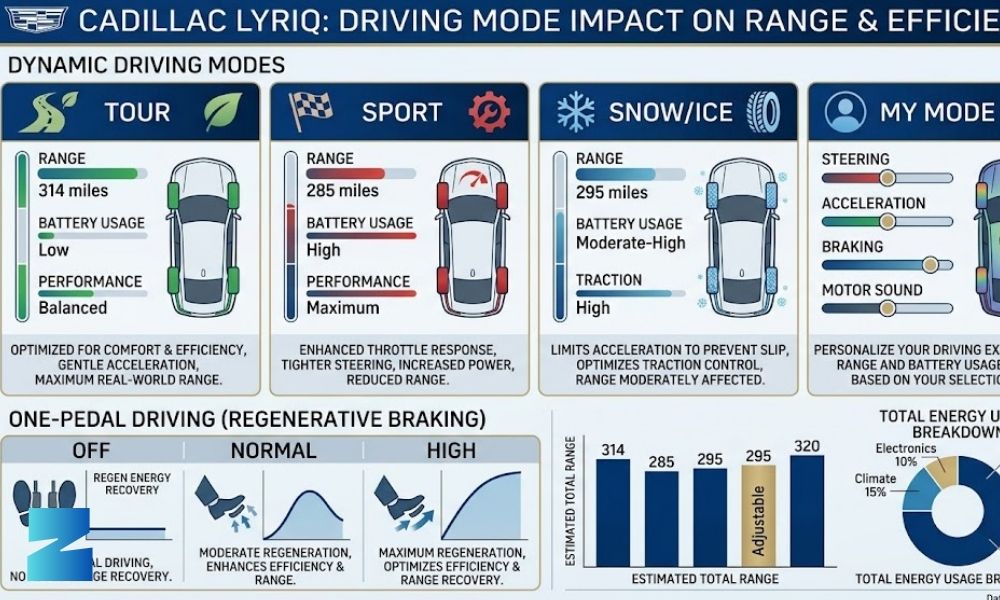
Many drivers get confused because the official range figure stays the same while their real-world range seems to shift from one mode to another. The reason is that official range is a standardized measurement. Real-world range is not. It changes constantly based on use.
If you drive at high speeds, use frequent hard acceleration, run strong cabin cooling or heating, carry extra weight, or drive in colder weather, range can drop even if the drive mode never changes. If you add a sportier mode to that mix, the effect may become even more noticeable.
That is why drive modes should be understood as part of a range system, not as the whole range story. The mode can influence the vehicle’s energy behavior, but it always works together with driver habits and road conditions.
Battery usage versus battery capacity
Another common misunderstanding is the idea that drive modes change the battery pack itself. They do not. The LYRIQ still uses the same battery capacity regardless of the selected mode. What changes is the rate at which stored energy may be used under different conditions.
This is an important difference. Battery capacity is like the size of your fuel tank. Battery usage is like how fast you burn through what is inside. The mode affects the second part much more than the first.
Once drivers understand that distinction, the whole subject becomes easier. You are not getting a new battery by choosing another mode. You are simply selecting a different personality for how the vehicle reacts, and that personality can influence how efficiently the energy gets used.
Regenerative braking and daily efficiency
One often-overlooked part of battery usage is regenerative braking. EV efficiency is not only about how energy is spent. It is also about how much can be recovered during slowing and braking. A smoother driving style usually gives regenerative systems a better chance to work consistently.
In daily driving, drivers who accelerate gently and slow down in a more controlled way often get better range than those who drive aggressively and brake hard. Even if the drive mode stays the same, this difference can be substantial.
That is why many EV owners focus more on habits than on mode labels alone. Drive mode matters, but it matters most when it supports a consistent, efficient style of driving. Good regenerative use, moderate speed, and smooth pedal inputs often matter more than a single switch on the console.
Temperature and climate control matter too
Even if a driver never changes modes, weather can still affect battery use in a very noticeable way. Cold temperatures, strong heating use, and even very hot weather with heavy air conditioning can all reduce practical range. These factors often matter more than the difference between two standard drive modes.
This is important for LYRIQ drivers because some people blame the mode when the bigger cause is actually the environment. Winter driving, uphill routes, fast highway cruising, and strong climate control use can all raise battery consumption.
So when comparing modes, drivers should be careful not to ignore the conditions around them. A range drop on a cold day in Sport mode may feel like the mode caused everything, when in reality the cold weather and cabin heat may be doing much of the work.
Which mode is best for daily range?
For most people, the best mode for range is the mode that makes the vehicle easiest to drive smoothly. In many cases, that will be the standard or everyday setting rather than the sportiest one. A calmer setup usually supports more measured acceleration and better efficiency in normal traffic.
This does not mean you must always avoid performance-focused modes. It simply means that if your top priority is stretching range, smoothness and moderation will usually help more than extra sharpness and speed. The best range often comes from consistency, not intensity.
Drivers who want to maximize battery life on longer trips are usually better off staying in the most balanced drive mode, using moderate speeds, and avoiding unnecessary bursts of hard acceleration. That combination tends to do more for practical range than any special trick.
Do different LYRIQ modes use the battery differently?
Yes, in practice they can. But the difference is not usually because one mode has its own official range number. The difference comes from how each mode changes the car’s behavior and how that behavior affects the driver’s energy use.
A performance-oriented mode can make the battery deplete faster if it encourages harder acceleration. A calm everyday mode can support better efficiency if it encourages smoother driving. A traction-focused mode may help in bad weather but may not improve range overall if the weather itself is already reducing battery performance.
So the most accurate answer is that the LYRIQ’s drive modes can lead to different real-world battery usage, but not usually in the form of clearly separated official range ratings for each mode.
The best way to think about LYRIQ driving modes
The simplest way to understand the issue is this: drive modes are more about vehicle behavior than battery math. They change how the car feels, how quickly it responds, and how confidently it handles certain situations. That can influence range, but usually indirectly.
If you think of a mode as a personality setting, the whole system makes more sense. One personality may be calm and efficient. Another may be sharper and more demanding. Another may focus on traction and control. The battery pack is still the same, but the way you use it shifts with the character of the car.
That is why two modes can produce different real-world results without ever having separate advertised range labels. The battery is not changing. The way the driver accesses and spends that battery energy is.
Final thoughts
The short answer to the question is yes, Cadillac LYRIQ driving modes can affect real-world battery usage, but usually not in the form of separate official range ratings. Everyday modes are generally better for smooth, efficient driving, while performance-focused settings can increase energy use by encouraging stronger acceleration.
For most drivers, the smartest approach is simple. Use the standard everyday mode for normal driving, save the aggressive performance settings for the moments when you really want them, and remember that weather, speed, and driving style often matter just as much as the mode itself.
That is the best way to understand the LYRIQ’s range story. The battery stays the same. The vehicle’s behavior changes. And that behavior, together with the way you drive, is what determines how far the charge really goes.
Detailed FAQs
Do Cadillac LYRIQ drive modes have different official range numbers?
Usually no. The LYRIQ is generally marketed with range figures based on vehicle version, not separate official range ratings for each normal drive mode.
Can LYRIQ drive modes affect real-world battery usage?
Yes. Different modes can change throttle response, traction behavior, and overall driving feel, which can influence how quickly the battery is used.
Does Sport mode reduce range in the Cadillac LYRIQ?
It can in real-world driving, especially if it encourages harder acceleration and more aggressive use of power.
Is the normal or everyday mode best for range?
In most cases, yes. A balanced daily mode usually makes it easier to drive smoothly, which often supports better efficiency.
Does Snow mode increase range?
Not necessarily. Snow mode is usually designed for traction and control, not maximum efficiency. Cold weather itself often reduces range regardless of mode.
Do performance-maximizing settings use more battery?
Yes, they generally can, because they are designed to deliver stronger acceleration and faster response.
Do drive modes change battery size?
No. The battery capacity stays the same. Drive modes affect how the vehicle uses that stored energy.
Is regenerative braking affected by driving style?
Yes. Smooth driving and controlled slowing usually help regenerative braking work more consistently, which can support better practical efficiency.
What affects LYRIQ range the most besides drive mode?
Speed, weather, cabin heating or cooling, terrain, tire condition, traffic, and driving style all have a major effect on range.
What is the best short answer to this question?
Cadillac LYRIQ drive modes can change real-world battery usage, but they usually do not come with separate official range ratings.

Lois Driggs Cannon: Biography, Family, Marriage to Buzz Aldrin, and Life Story

Julie Venables: Biography, Family, Health Journey, and Life With Brent Venables

Yazmin Cader Frazier: Biography, Career, Family, and Life With Kevin Frazier

Pixelspinx com Explained: Why This Growing Website Is Getting Attention

Ana Leza: The Private Life, Acting Career, and Marriage That Shaped Antonio Banderas’ Early Rise

Antonimar Mello: The Private Life Behind Lisa Lisa’s Marriage, Family, and Quiet Public Image
-
 NEWS3 months ago
Ana Leza: The Private Life, Acting Career, and Marriage That Shaped Antonio Banderas’ Early Rise
-
 CELEBRITY3 months ago
Antonimar Mello: The Private Life Behind Lisa Lisa’s Marriage, Family, and Quiet Public Image
-

 CELEBRITY3 months ago
Michael Ciminella: The Quiet Story Behind Naomi Judd’s First Marriage and Ashley Judd’s Family Name
-

 CELEBRITY3 months ago
Charity Nye: The Truth Behind Bill Nye’s Rumored Daughter and the Online Mystery
-

 CELEBRITY3 months ago
Patty Gardell: The Untold Story of Billy Gardell’s Wife and Family Life
-

 BLOG3 months ago
Dorothy Bowles Ford: The Quiet Story Behind the Ford Political Family Legacy
-

 CELEBRITY3 months ago
wedding charles latibeaudiere wife: Inside His Marriage to Barbara Sherwood
-

 CELEBRITY3 months ago
Becky Petrino: Family, Marriage, Children, and the Private Life Behind Bobby Petrino’s Football Career